
We're realtors, not contractors—and, truth be told, not even very handy. However, we've seen a lot of home inspections over the years and there are a few issues that are fairly easy to visually inspect before you get ready to make an offer.
Here they are:
Roof
There is an adage that contractors like to say: "All problems start with the roof." And, like most cliches, it's true. While there are now 30-year shingles available, 20 years is the usual lifespan for an asphalt shingle roof. Cedar shake lasts about 30 years and metal roofs can last 40-70 years. Expect the seller to know and disclose the age of the roof. Look carefully at the roof in the daylight and see if you notice any sagging, buckling or damaged shingles. If there are darkened pockmarks on the shingles, the roof may have hail damage, which could be remedied by the seller's insurance. Go into the attic and see if you see any water stains or signs of leaks on the underside of the roof. Keep in mind that some roof issues are easily fixable like leaks around a vent stack, an isolated instance of a few damaged shingles or a puncture from a fallen branch.
HVAC System
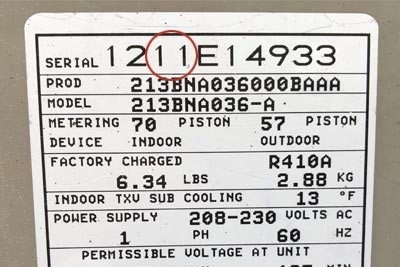
You won't find gas furnaces or boilers in the Lowcountry. Since temperatures rarely get below freezing, almost all of the HVAC systems are heat pumps. They are highly efficient for both heating and cooling and can usually last 10-14 years if regularly maintained (serviced every 6 months). Heat pumps consist of two components: an indoor air handler and an outdoor condenser. Some larger homes will have multiple heat pumps (referred to as zones). As a result, you'll want to check the dates of the heat pumps to plan for their eventual replacement and factor that into the purchase price for the house. Some labels will clearly state the manufacture date, but many will require getting the date from the serial number. Your agent will likely know how to do this. When you walk through a home, notice if there are rooms that have no venting or have large sections of the home serviced by separate mini-split units. It may be a sign that the home has not been properly climate controlled and there could be elevated levels of mold, which could require reconfiguring the entire HVAC setup. Along these lines, check the thermostats when you are at the house. If the temperatures are set to extreme levels for cost savings (i.e. over 78 in the summer) that may also contribute to a mold issue.
Pipes
It's important to check the year a home was built since it may reveal potential issues that were common at the time of construction. If a home was built between 1983 and 1997, there is a chance it has "the bad pipes." I'm referring to polybutylene (PB) plumbing pipes. The PB fittings of these pipes have a dramatically high failure rate and led to a class-action lawsuit. Starting in the late '80s, these pipes were used with copper fittings, which reduced the failure rate but are still a liability because chlorine is known to break down polybutylene over time. Most owners replace these pipes with PEX. Because we have mild winters, most plumbing pipes are not insulated and are easy to spot in attics or crawl spaces. If you see pipes that are dark grey and the date of construction matches the above dates, they are likely polybutylene. Another sign is if they have "PB" or "Poly-B" printed on them. Be sure to factor that into your offer and keep in mind that most homeowner insurance carriers, will not cover these pipes.
Fake Stucco
If a home you are considering has a stucco exterior and was built from the mid-1980s to the late-1990s, the exterior is likely fake stucco, which is also referred to as EIFS or synthetic stucco. If not properly installed and maintained, EIFS can be prone to water penetration, decay of the underlying plywood and even insect infestations. As a best practice, get a stucco inspection if you suspect a home exterior is EIFS. Stucco inspectors will not only confirm the type of exterior materials present, they will also use a thermal camera to identify any possible areas where there is a moisture intrusion issue that needs to be addressed. Most of the problem areas occur at the windows, doors and areas of kick-out flashing. As a quick test when you are at the house, try knocking on the stucco. If it feels hard as a brick, it's probably real hard-coat stucco. If it feels hollow like drywall, it's probably EIFS.
Flood Prevention
Hilton Head is a low-lying area and has many sections that are susceptible to flooding. As a result, it is important to confirm the flood zone and the elevation of the first-floor living space of any home that you are considering. Click here to identify a property's flood zone by address or on a map. For details on elevation, a surveyor needs to be hired to produce an elevation certificate. This is especially important in the southern areas of Hilton Head where the grade is usually 7-8 feet above sea level. The great majority of Bluffton and many areas on the north end of Hilton Head are designated as being in an "X Flood Zone," which means they have a much lower flood risk.
Most sellers in higher-risk flood zones will include an elevation certificate with their listing. Many properties on Hilton Head have elevation certificates on file with the town and are available here. There are three reasons why the elevation and flood zone matter:
- Flood Insurance Rates: With the recent FEMA flood map revisions (March 2021), most homeowners on Hilton Head will pay higher flood rates if their first-floor living space is lower than 8 feet above mean sea level.
- Renovation Potential: If the first-floor living space has an elevation that is lower than the elevation requirement for new construction (3 feet above the base flood elevation or 13 feet above mean sea level, whichever is higher), owners are only able to get a permit in the town of Hilton Head for 49% of the assessed or appraised value of the structure. For example, if the property is worth $500,000 with $250,000 land value and $250,000 structure value, an owner is only able to get a permit for a maximum renovation value of $122,500. Thankfully, that limit is not cumulative. As a result, you can close out the first permit for the maximum renovation value when the work is done and get another as long as the living area of the home is habitable (e.g. not stipped to the studs).
- Mortgage Requirement: If you are planning to get a federally insured mortgage to purchase a house in an A or V flood zone, you are required to get flood insurance.
While there are dozens of other important items to pay attention to (e.g. flooring, windows, dry rot, pool, electrical, etc), these five are easy to visually inspect and can be costly if overlooked. Thankfully, hiring a good inspector will take the pressure off of you to properly evaluate the condition and safety of a home. Ask your agent for a trusted home inspector as well as what inspections and surveys are appropriate for the home you are considering. Let us know if you have any questions.